Guide to New Hampshire Marriage Records
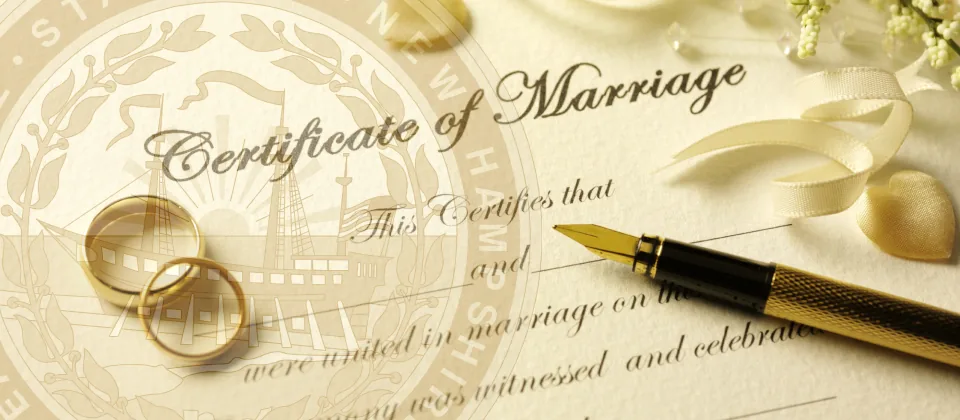
New Hampshire marriage records are official documents that trace a couple's legal union from the marriage license application to the marriage certificate. Usually, these records list both spouses' full names, the date and town of the ceremony, and the officiant who performed the marriage. Depending on the type of record, they may also include details such as each spouse's age, birthplace, or occupation at the time of the wedding.
The term “marriage record” is often used to describe documents such as a marriage license and a marriage certificate. While they are related documents, they are not the same. A marriage license serves as the state's official permission slip, allowing a couple to marry. A marriage certificate, on the other hand, is the document signed after the wedding that proves the wedding ceremony took place. However, a complete marriage record includes both of these items along with any background details or applications submitted during the process.
New Hampshire residents perform marriage record lookups for many purposes. For instance, a certified copy of a marriage certificate may be used to prove a marital status for government benefits, insurance, immigration, or other legal matters. It can also be used as evidence of a name change.
Older marriage records are also useful for genealogists. Historical marriage records may identify parents, previous surnames, birthplaces, residences, and other details that help connect generations of a family.
Types of Marriage Records in New Hampshire
| Record Type | Purpose | Issued By | Validation/Notes |
|---|---|---|---|
| Marriage license | Allows eligible applicants to marry. | City or town clerk. | Valid for 90 days. |
| Marriage certificate | Provides official evidence that the marriage took place. | Division of Vital Records Administration (DVRA) or a city or town clerk. | Certified copies may be used for legal and administrative purposes. |
| Historical marriage records | Used for genealogy and historical research. | State Archives and other genealogical databases. | Marriage records more than 50 years old are considered public. |
Examples of New Hampshire marriage records include the following:
Marriage Certificates
A marriage certificate serves as the primary evidence of a complete wedding. It contains details such as the couple's identities, the date, the location, and the officiant's signature. This document typically has a raised seal and is required to update a passport with the U.S. Department of State or change a name after marriage with the Social Security Administration.
In New Hampshire, official copies of marriage certificates are issued by town clerks or the New Hampshire Division of Vital Records Administration (DVRA).
Marriage Licenses
A marriage license is the formal document that a couple must obtain before the wedding can take place. It ensures that the couples named on the document meet all legal requirements to wed in New Hampshire.
Note that the marriage license is different from a marriage certificate. The certificate can only be issued after the couple has said their vows and completed the ceremony. However, a marriage license is issued prior to the wedding.
Once issued, a New Hampshire marriage license is valid for 90 days.
Are Marriage Records Public in New Hampshire?
Vital records, including marriage records, are not public records in New Hampshire. Under RSA 5-C:9, a registrar generally cannot allow anyone to inspect a marriage record or disclose its information unless the requester has a direct and tangible interest in it.
State law defines individuals with a direct and tangible interest in a marriage record as the people named on the record and their immediate family members. Legal guardians and legal representatives of the spouses on the record can also qualify. The state also allows an individual who needs the record to establish or protect a personal or property right to access this record upon proving the need.
Accessibility rules for New Hampshire marriage record changes as the records get older. Per RSA 5-C:105, marriage records older than 50 years can be accessed by the general public, including genealogical researchers. In line with this, the Division of Vital Records Administration releases records that entered the public domain during the previous calendar year by April 1.
What Information Is Included in a Marriage Record?

A standard New Hampshire marriage record typically features the following information:
- Full names and current residential addresses
- Dates of birth, ages, and birthplaces
- Occupations of both individuals
- Parents’ full names, birthplaces, and occupations
- The number of times each person has been married
- Marital status before the wedding (single, divorced, or widowed)
- Date and location of the wedding ceremony
- The name, title, and address of the officiant
New Hampshire takes privacy protection seriously and does not allow sensitive personal details contained in marriage records to be released publicly. Data such as Social Security numbers, medical information, and other specific personal tracking data collected for state health statistics are redacted from public view.
How to Find Marriage Records in New Hampshire
Step 1: Identify the Marriage Details
Obtain as many details about the marriage as before commencing the search. For example, gather the full names of both partners, the exact or approximate date of the wedding event, and the specific city, town, or county where the ceremony took place.
Step 2: Find the Record Custodian
Marriage records in New Hampshire are maintained at both the local and state levels. For modern marriage records, the DVRA in Concord is the primary custodian. However, any local city or town clerk may access the central state database for records from 1960 to the present. Requesters seeking historical records dating between 1892 and 1922 may contact the New Hampshire State Archives.
Step 3: Choose How to Search
There are several ways to access New Hampshire marriage records. Typically, access is available via online, in-person, mail, and historical database means. Requesters who want a recent marriage record may submit an application online via VitalChek or EB2Gov, third-party services approved by the state.
Those who prefer to mail options may send completed applications to the custodian, while in-person visits are available at town clerk offices. Genealogical databases like FamilySearch offer online access to older, unrestricted marriage record indexes.
Step 4: Submit a Record Request
Requesters must submit a completed application form along with a photocopy of an acceptable form of photo ID, such as a driver’s license. Also, a $15 non-refundable application fee is required for processing the application, which includes the cost of the first copy if records are found, while subsequent copies will cost $10 each.
Requests made online or through mail normally take a few weeks, while in-person requests are often fulfilled instantly.
How to Get a Certified Marriage Certificate in New Hampshire
To obtain a certified marriage certificate, the applicant must demonstrate a direct and tangible interest in the requested record. Under state law, several people may be considered to have a direct and tangible interest in the record. These include the spouses named on the record, immediate family members, guardians, and legal representatives. A person may also qualify if they can show that the information is needed to protect or determine personal or property rights.
To obtain a certified marriage certificate copy, an applicant must fill out an Application for a Certified Copy of a Vital Record and submit it with the payment and proper identification to:
NH DEPARTMENT OF STATEDIVISION OF VITAL RECORDS ADMINISTRATION
REGISTRATION / CERTIFICATION
9 RATIFICATION WAY
CONCORD, NH 03301-2455
Acceptable identification documents include a driver's license, passport, or other photo identification. In the absence of acceptable picture ID, the requester must complete the Documentation Evidence for Individuals Not Possessing An Acceptable Picture Identification. In addition to the DVRA, a request for a certified copy of a marriage record may be submitted to the relevant local city or town clerk.
The fee for the search and the first certified copy is $15, and $10 for any additional copies obtained at the same time. It is also important to note that this $15 fee is usually charged regardless of whether the searched record is found.
Requests can be placed by mail or in person, and online ordering may also be available through approved third-party services such as VitalChek and EB2Gov. Note that these services charge additional processing or delivery fees. In-person requests are available and are often processed on the same day. Mail orders generally take about 20 business days to arrive, starting from the time the request arrives at the state office.
You need to order a certified marriage certificate if you intend to submit it as proof of marriage for legal or administrative actions.
How to Get a Marriage License in New Hampshire
Couples seeking to marry in New Hampshire may visit any town or city clerk's office in the state to submit an application for a marriage license. The state does not require marriage-license applicants to submit their application in the area where they live. New Hampshire allows both its residents and people from outside the state to apply for a marriage license.
While the application may be initiated by either applicant, both applicants generally must appear before the clerk to sign the application. However, the state provides limited exceptions where an individual cannot appear due to circumstances such as documented medical reasons or certain military situations.
Proof of identity and age is required by the clerk's office when applying for a marriage license. An applicant can provide a certified birth certificate, a passport, a driver's license, or another photo ID document that shows the applicant's name and date of birth. Note that if one of the applicants was previously married, the clerk will request proof that the previous marriage has ended. Acceptable proofs include a divorce decree or a death certificate.
The legal minimum age for getting married in New Hampshire is 18. Furthermore, upon paying the statutory marriage license fee of $50 and meeting the age and application requirements, an applicant may obtain their license immediately. No waiting period exists between application and license issuance. Once issued, a license remains valid for up to 90 days.
The marriage ceremony must be performed by someone authorized to solemnize marriages under New Hampshire law. This includes qualifying justices of the peace, judges, and clergy. However, other people may be able to perform a marriage after obtaining the appropriate special marriage officiant license from the Secretary of State. No witnesses are required under state law to be present at a New Hampshire wedding ceremony.
After the wedding, the officiant must certify the marriage and return the record to the clerk who issued the marriage license within six days.
Who Can Request Marriage Records?
Since New Hampshire treats marriage records as closed records, access is limited to a defined group of people, categorized as having a direct and tangible interest in the record.
They include the following:
- The spouses named on the record themselves.
- Immediate family members, such as parents, children, siblings, grandparents, grandchildren, great-grandchildren, step-parents, step-children, aunts, uncles, nieces, and nephews.
- Legal guardians acting on behalf of one of the spouses.
- Government agencies conducting official business
- Attorneys or other authorized representatives with a legitimate legal interest.
Third parties who are not immediate relatives may only access a restricted record by presenting a signed, notarized authorization from a spouse or a clear court order explaining their direct legal need.
However, once a record is more than 50 years old, it becomes accessible to researchers and the public.
Free and Online Marriage Record Searches

There are no official free online options for searching recent marriage records in New Hampshire. However, anyone can search historical records online at no cost. Some city and town clerks maintain searchable databases that the public may use when searching historical records.
Also, FamilySearch, a genealogical marriage record platform, provides access to several collections of New Hampshire marriage indexes. These collections typically draw from civil registrations and church records. However, the collections may not be complete for every location or period.
Ancestry is another historical marriage database that provides access to New Hampshire records of marriages from 1700 to 1974. This database contains details such as names, ages, birth dates, parents' names, spouses' information, marriage dates, marriage places, and certificate numbers. Access to Ancestry records may require a subscription or access through a participating library.
Note that if you need an official certified copy, a paid request is necessary. The state's standard search fee is $15.
Common Law Marriage in New Hampshire
New Hampshire does not recognize common-law marriages based solely on living together for a period of time. However, under RSA 457:39, two people living together may be considered to be in a legal marriage under certain conditions. For this to happen, the individuals must have lived together and acknowledged each other as spouses for a minimum period of three years until the death of one of them.
This rule is important in cases of inheritance and probate; however, it does not mean that couples automatically gain married status after living together for three years while both remain alive.
New Hampshire recognizes common-law marriages validly established outside the state. A couple moving into New Hampshire who are in a common-law marriage legally formed in a state where the union is legal will be considered married in the Granite State.
Be aware that a relationship recognized under New Hampshire's limited post-death rule will not necessarily have a conventional marriage license or certificate issued when the couple began living together. Establishing the relationship may instead require evidence in an estate or other legal proceeding.
How to Correct an Error on a Marriage Record
Errors are sometimes found on marriage records. These errors can include misspelled names, incorrect birth locations, and other mistakes related to the parents' details. The process of correcting an error on a marriage document may involve the spouses named on the document, the marriage officiant, and the clerk who originally issued the marriage license.
If you want to amend a marriage record error, you must submit an amendment application (Form VSCr) to the local clerk's office where you obtained your marriage license. The amendment application must be signed and notarized. If you notice an error in the marriage record within 6 months of the wedding ceremony, you can expect the local clerks to resolve the error via a simple, expedited process. Errors made by the clerk may be corrected free of charge.
In addition to the completed amendment form, you must provide evidence proving the error. The state typically requires applicants to provide two forms of proof for significant corrections. These documents include official documents, such as:
- Other certified vital records (such as your birth certificate)
- Early school records or employment records
- Certified military discharge paperwork or census records
- Properly executed, notarized affidavits
The state imposes a $10 fee to correct a marriage record. You will be required to pay a $15 fee to obtain a new certified and corrected copy.
Note that substantial name changes, such as when you wish to change an identity rather than correct a spelling mistake, generally involve a more complicated process. In such a case, you will be required to submit a certified court order from a judge.
Marriage Records and Name Changes
The marriage process in New Hampshire allows either spouse to keep the surname used before marriage, take the other spouse's surname, or use a hyphenated combination of both surnames. It is also possible to use the previous surname as a middle name. Whatever name is chosen, it is entered on the marriage application and marriage license as the name to be used after marriage.
After marriage, the certified marriage document may be used as evidence when updating records with government agencies. For example, the Social Security Administration accepts a marriage document as proof of a legal name-change event when its requirements are met. Similarly, the New Hampshire DMV procedures recognize a marriage certificate as documentation supporting a legal name change in certain motor vehicle records.
It is important to note that changing a person's name after marriage is different from amending the marriage record. A correction amends an error that was made when the marriage record was created, while a name change only creates or recognizes a new legal name.
Marriage Records for Genealogy and Family History
New Hampshire's DVRA has a Genealogical Research Center in Concord that offers a valuable resource for researchers seeking older marriage records. The marriage record collection held by this center dates back several centuries to around 1640.
Genealogists tracing family history can also use the historical database, FamilySearch. Its New Hampshire, Marriage Records, 1637-1947 collection contains more than half a million indexed records and provides images in many cases. Researchers can also use the FamilySearch New Hampshire, Marriages, 1720-1920 collection.
Other options include New Hampshire, Town Clerk, Vital and Town Records, 1636-1947, and Ancestry's New Hampshire, U.S., Marriage Records, 1700-1974 collection. The former was compiled from local town clerk records, while the latter may provide information on the couple and their parents.
Note that searches conducted via these platforms can be narrowed by a spouse's name, marriage location, family member, or approximate date. For older records, researchers are advised not to rely solely on county names. Since state marriage records were commonly maintained by town and city clerks, knowing the town where the couple lived or married may be more useful than knowing only the county.
Furthermore, older records are sometimes incomplete. This is because spellings can vary, handwriting may have been interpreted incorrectly during indexing, and some early events were not reported. Hence, it is recommended that information found in an online index be compared with the original record or an official copy.
Frequently Asked Questions
Are marriage records public in New Hampshire?
New Hampshire marriage records are not open to the public for the first 50 years.
How can I find a marriage record by name?
Marriage records can be searched through free historical sources such as FamilySearch or a paid request to the relevant town clerk in New Hampshire.
Can I search marriage records online for free?
Yes, you can access old marriage records for free through the state archives and historical indexes on FamilySearch. Recent marriage records cost a fee.
How much does a marriage certificate cost?
A marriage certificate costs $15, plus $10 for each additional certificate requested at the same time.
How long does it take to get a certified marriage certificate?
In-person requests at the town clerk's office are processed on the same day, while online and mail applications may take up to 20 business days.
Can someone else request my marriage certificate?
Yes, if they are your immediate family member, spouse, legal representative, or other person with a direct and tangible interest in the record.
What is the difference between a marriage license and certificate?
A license is the permission granted before the wedding that allows a couple to legally marry. A certificate is the proof issued after the ceremony that the marriage actually happened.
Table of Contents
- Types of Marriage Records in New Hampshire
- Are Marriage Records Public in New Hampshire?
- What Information Is Included in a Marriage Record?
- How to Find Marriage Records in New Hampshire
- How to Get a Certified Marriage Certificate in New Hampshire
- How to Get a Marriage License in New Hampshire
- Who Can Request Marriage Records?
- Free and Online Marriage Record Searches
- Common Law Marriage in New Hampshire
- How to Correct an Error on a Marriage Record
- Marriage Records and Name Changes
- Marriage Records for Genealogy and Family History
- Frequently Asked Questions